
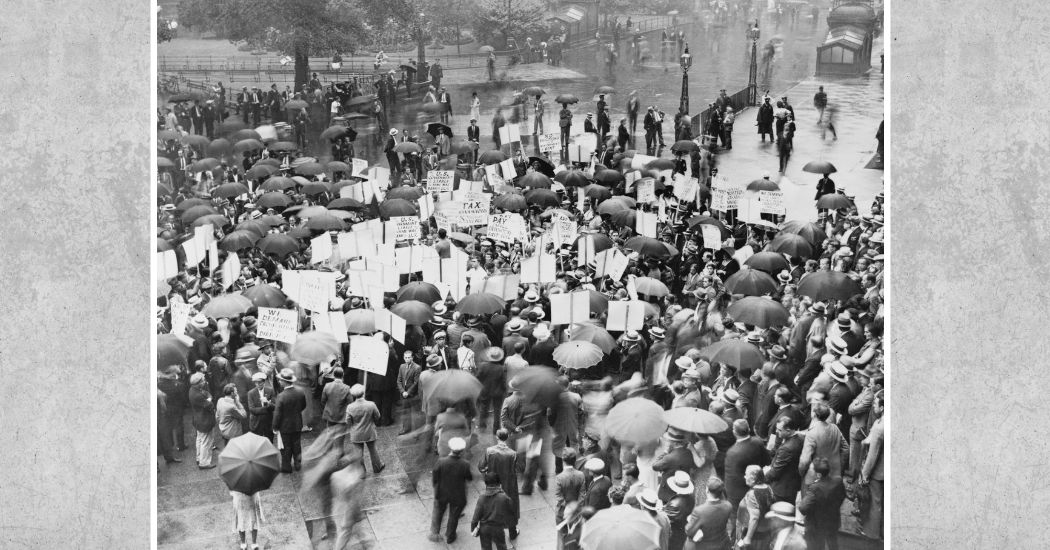
Welcome to our Great Depression trivia quiz, where we delve into one of the most challenging times in American history: the Great Depression.
In these trivia questions, we’ll test your knowledge about the causes, effects, and significant events of this era that shaped the nation.
Get ready to learn and reminisce about this pivotal period with 35 thought-provoking quiz questions all about the Great Depression in the USA. Let’s jump right in!
* This post may contain affiliate links. You won’t be paying a cent more, but in the event of a sale, the small affiliate commission I receive will help keep this blog running/pumping out useful content. Thanks!
Question: What event is considered the start of the Great Depression?
Answer: The stock market crash of 1929, specifically Black Tuesday on October 29, 1929.
Question: What was the primary cause of the stock market crash of 1929?
Answer: The rapid and reckless expansion of the U.S. stock market, where stock prices were much higher than their actual value.
Question: What was the name given to the period of severe dust storms that ravaged the Southern Plains during the Great Depression?
Answer: The Dust Bowl.
Question: Which states were most affected by the Dust Bowl in the USA?
Answer: Texas, New Mexico, Colorado, Nebraska, Kansas, and Oklahoma.
Question: Roughly how many people left the Dust Bowl states during the 1930s due to the environmental disaster?
Answer: Approximately 2.5 million people.
Question: What term was used to refer to the Dust Bowl refugees, particularly those from Oklahoma?
Answer: “Okies.”
Question: What region in California did a significant number of Dust Bowl migrants settle in?
Answer: The agriculturally rich San Joaquin Valley.
Question: Which photographer documented rural poverty during the Dust Bowl era for FDR’s Farm Securities Administration?
Answer: Dorothea Lange.
Question: Which artist achieved renown with his Dust Bowl landscapes, capturing the environmental devastation of the era?
Answer: Alexandre Hogue.
Question: What was the nickname for the makeshift communities of homeless people during the Great Depression?
Answer: Hoovervilles.
Question: What was the global economic system that helped spread the effects of the Great Depression throughout the world?
Answer: The gold standard.
Question: Who was the President of the United States when the Great Depression began?
Answer: Herbert Hoover.
Question: Who was the longest-serving President of the United States, serving from 1933 to 1945, and leading the country through the Great Depression and World War II?
Answer: Franklin D. Roosevelt (FDR).
Question: What were the series of radio broadcasts by President Franklin D. Roosevelt called, which aimed to communicate directly with the American people during the Great Depression and World War II?
Answer: Fireside Chats.
Question: Which New Deal program employed young men to perform conservation and infrastructure projects during the Great Depression?
Answer: The Civilian Conservation Corps (CCC).
Question: Which famous novel by John Steinbeck, published in 1939, depicts the struggles of migrant workers during the Great Depression?
Answer: The Grapes of Wrath (Book | Movie)
Question: Who was the First Lady of the United States during the Great Depression and a strong advocate for social reform?
Answer: Eleanor Roosevelt.
Question: At the height of the Depression in 1933, what percentage of the total workforce in the United States was unemployed?
Answer: About 25%.
Question: What did FDR pledge to the American people during his speech accepting the Democratic Party nomination in 1932?
Answer: “A New Deal for the American people.”
Question: What was the name given to the package of legislation pushed through Congress by FDR in the First Hundred Days of his presidency?
Answer: The New Deal.
Question: What did the letters in the acronym “AAA” stand for, in the context of the New Deal?
Answer: Agricultural Adjustment Administration.
Question: What did FERA and WPA provide to thousands of unemployed Americans during the Great Depression?
Answer: Jobs in construction and arts projects.
Question: Which New Deal agency sought to stabilize consumer goods prices through a series of codes?
Answer: National Recovery Administration (NRA).
Question: What notion did FDR adopt from John Maynard Keynes to stimulate aggregate demand during the Great Depression?
Answer: Expanded deficit spending.
Question: What were “Okies” during the Great Depression?
Answer: Victims of the drought and dust storms in the Great Plains who migrated to California in search of work. The term was usually referring to “white” migratory agriculture workers.
Question: Which New Deal agency brought electricity to rural areas for the first time?
Answer: Tennessee Valley Authority (TVA).
Question: What did the Home Owners Loan Corporation (HOLC) aim to do during the Great Depression?
Answer: Provide relief to homeowners facing foreclosure.
Question: Which New Deal agency legalized the workers’ right to unionize?
Answer: National Recovery Administration (NRA).
Question: What was the name of the set of laws passed by Congress during the Great Depression aimed at regulating the banking system and stock market?
Answer: The Securities Exchange Act and the Banking Act of 1933 (also known as the Glass-Steagall Act).
Question: Which iconic American building was completed in 1931 during the Great Depression?
Answer: The Empire State Building.
Question: Which iconic film directed by Charlie Chaplin, released in 1936, satirized the industrialization and economic struggles of the Great Depression?
Answer: “Modern Times.”
Question: Which government agency was created to insure depositors’ accounts and stabilize the banking system during the Great Depression?
Answer: The Federal Deposit Insurance Corporation (FDIC).
Question: Which legislation, passed during the Great Depression, provided Americans with unemployment, disability, and pensions for old age for the first time?
Answer: The Social Security Act of 1935.
Question: What was the name of the large-scale public works program that employed millions of people during the Great Depression?
Answer: The Works Progress Administration (WPA).
Question: What was the primary factor that eventually ended the Great Depression?
Answer: The manufacturing production increases driven by World War II.
If you enjoyed reading this article, check out some of our other history-related trivia topics and quizzes!

Celebrating Heritage: 45 Black History Month Trivia Questions
As Black History Month unfolds, we invite you to learn something new with our Black History Month trivia. We will be exploring the remarkable events, resilient figures, and pivotal moments that have shaped African American history. From the iconic leaders of the civil rights movement to groundbreaking moments in arts and culture, our trivia is…
105 Greek Mythology Trivia Questions That Even The Gods Would Love
Hello, dear trivia lover (or fanatic)! Are you a fan of Greek mythology and its fascinating stories of gods, heroes, and monsters? If you subconsciously raised your hand, you’re in for a treat! In this post, we’ve compiled a list of some of the most intriguing and challenging Greek mythology trivia questions and answers to…
US Presidents Trivia: 77 Questions To Prove You’re A Pro
Welcome to our fun-filled trivia article all about U.S. presidents, where US history meets quirky facts! Ever wondered which president kept a pet alligator in the White House or which commander-in-chief had a pet goat named Nanny? Sounds crazy, but everything you’ll encounter below is the cold, hard truth! We’ll dive into some of the…

Blast From The Past: 175 Trivia Questions For Seniors
If you (or some lucky seniors you know) are looking for a fun way to reminisce about the good old days, then you’re in for a treat! In this trivia post curated specifically for seniors, we’ll be covering a range of topics from the past, including movies and stars, music, TV shows, brands and products,…
110 English Kings and Queens Trivia Questions and Answers
Welcome, royal enthusiasts! If you’re looking for a fun and challenging way to test your knowledge of English monarchs, then you’re in the right place. In this post, you’ll find a variety of trivia questions about kings and queens throughout history, as well as some questions about the current Royal Family and even some from…
The Royal Family: 50 Trivia Questions Inspired by The Crown
Hey, royal enthusiasts and trivia buffs! In this post, we’re diving deep into the fascinating world of the British royal family. You can’t argue it — they are a fascinating bunch. Otherwise, there wouldn’t be boatloads of shows and movies about ’em. We’ll start with some questions about the real-life royal family, including the iconic…
US History Mega Quiz: 185 Trivia Questions To Test Your Brains
We have a super special trivia quiz for you today — a mega US history trivia quiz — because there’s just too much history in our country to have a normal-sized set of trivia questions. From the early days of Colonial America to the tumultuous years of the American Revolution and the forging of a…
60 Fun And Fascinating Trivia Questions All About Pirates
Today, we’re diving DEEP into the swashbuckling world of pirates! From the infamous Blackbeard to the fierce Anne Bonny, the history of piracy is rife with tales of daring adventures, hidden treasures, and legendary rogues that have captured the imaginations of pirate lovers for centuries. But why are pirates such an intriguing topic? Perhaps it’s…
WWII Trivia Questions: Can You Answer All 60 Questions Correctly?
Today, we’re going on a ride through one of the most pivotal periods in human history: World War II. In this WWII trivia quiz, we’ll put your knowledge to the test with a series of trivia questions designed to challenge even the most seasoned armchair historians. From the main players in the war to the…
55 History Trivia Questions All About Ancient Egypt
Does the ancient civilization of Egypt just intrigue the heck out of you? We’re raising our hands for this one! Egypt boasts one of the world’s oldest and most influential civilizations, dating back over 5,000 years. Its rich history includes remarkable achievements in architecture, art, science, and literature, leaving behind a legacy that continues to…
